

The problem that nobody solved
The conventional semiconductor industry has everything under control. It has machines for manufacturing chips as well as diagnostic tools to check that everything is working properly along the way. Without those checks, the chip yield would be around 40 percent instead of the current 80 percent.
For quantum chips, that second part doesn’t exist yet. “You can’t use a standard inspection tool on a quantum chip. You’ll see all sorts of things, but not the defects that actually matter.” Johannes explains.
As a result, the production yield for quantum chips is currently somewhere between 10 and 20 percent. The chips cost millions each, and sometimes a manufacturer sells only one per month.
From university to business
The story of QuantaMap begins across the street from their current office in BioPartner 4, in the laboratories of Leiden University.
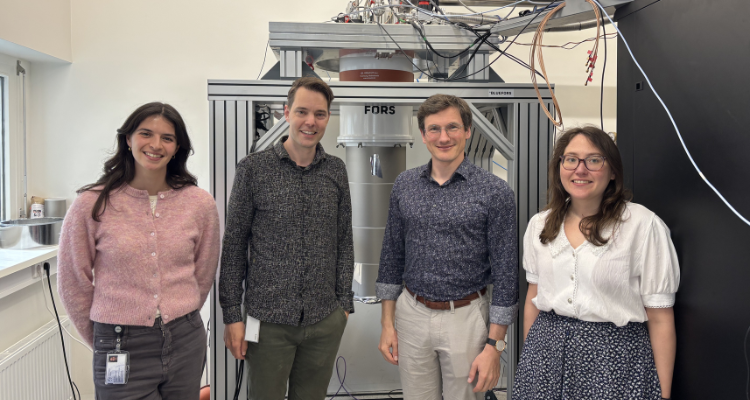
There, Johannes and his co-founders, Kaveh Lahabi and Milan Allan, developed a measurement technology that captures unique images of quantum chips at temperatures near absolute zero. At some point, they realized: this isn’t just interesting for science.
“We’re really a classic spin-off. We commercialize technology that was largely developed right here, literally across the street.”
The decision to start a business wasn’t made overnight. For nearly a year, they worked on the business plan in the evenings, mostly as a side project. It wasn’t until the initial funding was secured that Johannes quit his job.
PLNT as a starting point
Before QuantaMap really took off, Kaveh and Milan were looking for guidance. They found it through PLNT’s Venture Academy program.
“As an academic, I knew absolutely nothing about starting a business. It was a crash course in the basics. Now those things seem obvious, but at the time we felt completely lost,” said Kaveh.
At Venture Academy, the team learned about funding options, what investors look for, and how to structure a pitch. But the community surrounding it was just as valuable.
“It was nice to talk to other people going through the same thing. We were able to help each other and figure things out together.”
The network Kaveh built at PLNT later proved to be a real asset. Someone from PLNT put Kaveh in touch with a co-founder of another quantum startup, who then connected him with the right people at QDNL.
“That connection helped us secure our first round of funding and our first loan. Without that introduction, our journey would have looked very different.”
Pitching a hundred times
The biggest challenge in the early stages was figuring out what the company is actually worth to others.
“You need to find the right person within other organizations someone who understands the technology and is in a position of authority to make a purchasing decision.”
The team ended up giving about a hundred pitches before they received any truly useful feedback. Some people were just being polite, and that didn’t help.
“When someone tells you that it’s useless to them, it’s hard to accept at first. But in the end, it helps you a lot more.”
Hardware also comes with its own delays. The lead time for a cryostat, the cooling unit they need, is six months. Spending more money won’t help with that.
Growing in Leiden
QuantaMap got its start in the labs at Leiden University. While essential in the early stages, the space soon became too cramped for a growing company.
The team is now based in a BioPartner 4 building in the heart of the Leiden Bio Science Park, part of the broader ecosystem that also includes PLNT. Leiden is currently working on 8 of the 10 key technologies identified by Europe. Key Region Leiden raises awareness of these key technologies and ensures that stakeholders within the ecosystem can connect with one another. Quantum is one of the key technologies, which QuantaMap works on every day.
Other cities are also easily accessible; for example, QuantaMap actively collaborates with partners such as QuantWare, TNO, and VSSL, almost all of which are based in Delft.
“Delft is just twenty minutes away. It’s really just the same city. In Germany, where I’m from, the next town is often a two-hour drive away,” said Johannes.
That proximity fosters a culture of openness. Companies in the quantum sector know each other, do not view each other as competitors, and actively help one another, even with the less glamorous tasks.
““If I need a lawyer who specializes in intellectual property, I call a few other founders and ask who they recommend. That’s very different from just hearing about a ‘good law firm’ in general.”
What no one had seen before
The images produced by QuantaMap are unique. They are taken at one Kelvin and show how magnetic fields behave and how electric currents meander around defects.
“No one has ever seen this before. We show a customer something, and suddenly they have an explanation for something they’ve been puzzling over for years.”
“They always noticed an unusual signal but never knew why. We made it visible. And they were happy to pay us for that.”
The Dream
In five years, QuantaMap aims to be the go-to choice for quantum chip diagnostics, a position comparable to that of ASML in the traditional chip industry.
The ultimate goal goes beyond market share.
“Ultimately, our instrument needs to be in every quantum chip factory in the world.”
His advice to other researchers with a quantum idea is simple: just get started.
“The Netherlands is a great place to start; there’s capital available. And talk to people who’ve done it before, because almost everyone is willing to share their experiences.”
This interview was written in collaboration with Key Region Leiden.
