

How did you guys come up with the idea of making such a game?
Dennis: “In 2019, we did our bachelor’s at the university here, at the same study we are now doing the master’s from. Which is about cells, microbiology, dna and a bit of pharmacy. We both love gaming, and over a beer we figured we wanted to play a game related to the study, in which immune systems battle infectious diseases. But that didn’t exist yet, so we thought: let’s make it ourselves. In a short time we had come up with many card ideas with diseases: tuberculosis, polio, hiv. We cut paper cards and drew with pencil, and then we started testing to see if it worked.
“A little later, we had also created a mystery virus card, with the idea: there’s bound to be a new disease showing up somewhere. Then you already have a card that could be anything. And so a short time later, a mysterious virus really showed up in Wuhan.”
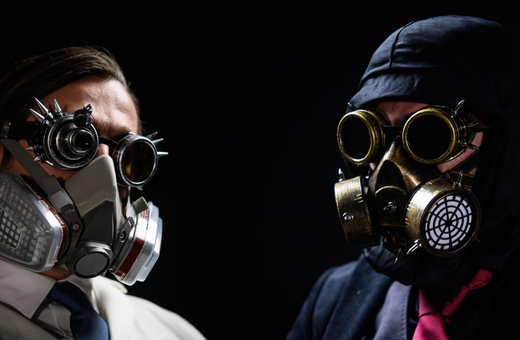
Rafael: “Depending on who you ask, we predicted or caused the corona pandemic. Mr. Black would prefer to infect the entire world and Mr. White wants to prevent that.”
"We help each other with things like LinkedIn, marketing and financing. Everyone has their own expertise. You realize you're not alone."
Has coronapandemic and monkey pox outbreak increased interest in your game?
Rafael: “It’s very silly to say, but this has been fortunate for us. All at once, the whole world is concerned with the concept of a virus, something people almost never thought about before. So that did indeed make our story easier to tell.”
But surely there are those who want to know precisely nothing about it?
Dennis: “Later, when we noticed with corona that there was a lot of resistance to corona measures – people didn’t understand what a virus was, what a vaccine entailed – we thought: maybe we can make a really good impact by spreading scientific information to people in a very manageable way with this game.
Rafael: “Yes, that distrust has been extremely on tilt in recent years, partly because of covid. One of the big reasons this can continue to breed in your mind is ignorance. That leads to fear, fear leads to distrust, and distrust leads to resistance. You can try to counter resistance with logical arguments, but then you’re really just fighting symptoms. So we decided – since we were developing the game anyway – to focus a little more on the scientific content, to be able to pull out all the ignorance at the root.
“We told friends of ours for years about our studies, with that going in one ear and out the other. However, we only had to play one game of ImmunoWars and suddenly they started to mention terms, they recognized cells and knew what they did.”
How does the game work? What is the goal?
Dennis: “As you can see, there are cards of all kinds of dangerous infectious diseases in the box. Here, for example, you have a map of triple E, a disease few people know about. It stands for eastern equine encephalitis. The map shows how difficult it is to cure. In this case super difficult, there’s really no getting rid of this. Another little symbol indicates infectivity, here: not contagious.
“Where most games are all about: find the weakest link and kill it, in ImmunoWars the weakest link can have Ebola. If you get too close to that, you can get Ebola yourself. So you also have to think strategically, do I want to wet the person to make him dead?”
“ImmunoWars is meant to teach what diseases exist and what you can do about them. It also includes techniques that are actually very new, such as 3D printed personalized medicine, which has exactly the right amount of medicine in it, so you get fewer side effects.”
How do you get new information?
Dennis: “During the lectures we wrote down a lot of things, each time with the idea: we can make a card of this. And so we try to sail with the scientific sector. And of course, we also read popular science magazines like New Scientist and C2W that sometimes have very cool articles in them. And they also do it in a very accessible way.”
Rafael: “Most people are completely unaware of what is happening at all and what the latest developments are. Knowledge is also very inaccessible, scientific publications are unreadable for an average person. We want to offer it in a playful, dynamic way for a very large audience.
“We put a layer of storytelling on top of that from Mr. B. Black against Mr. White, bioweapons versus medicines. Through entertainment, we can appeal to a larger group than just scientists. That way we can connect the serious sector and the fun sector.”
Zo kunnen we de serieuze sector en de lollige sector met elkaar verbinden.”
Rafael: “In the end, it did go reasonably well under the circumstances. It was spirited though, bit of bad sleep for it, but ended up being nice. Good enough.”
Dennis: “Yes, you sat through to the end! But the assignments in the exam were about cancer vaccines. It would be great if such a cancer vaccine comes along, then we can make a map of that. Because with our game, we want to communicate all the latest innovations, drugs, vaccines and infectious diseases.”
Rafael: “Yes, that’s the beauty of it. Science is running at full speed, constantly coming up with new discoveries and innovative solutions. We can then immediately gamify those.”
How do you guarantee that you give objective information?
Dennis: “Fair question. We don’t do it sponsored or branded. So suppose Pfizer has a new vaccine and wants it in play, we don’t. We just want to be educational.”
Rafael: “No, we are not a signboard. It’s very simple, we can only do our mission well if the audience keeps trusting us. Therefore, it’s best for everyone if we can keep that layer of authenticity in there.”
Having such a game made is quite expensive, how did you guys do it?
Rafael: “Part of it is equity, and last summer we also ran a crowdfunding campaign. That went well; we achieved 140 percent of our intended goal. There were also some companies that liked what we were doing and ordered fifty games in advance, for example. They paid in advance, so that meant we already had some money to produce some prototypes and do some market research.”
Dennis: “We also participate in a collaboration between LUMC and Rabobank and this building, PLNT. They offer small start-ups and entrepreneurial students who are nearing or have recently graduated a very soft loan. Then you have at least a little bit of liquidity, and so that allowed us to realize the first printing of the game. Therefore, we also had to set up a company, the proceeds had to be deposited somewhere, and the loan had to be in someone’s name. So yes, that can be added on top of your student debt.”
Are you earning anything from it yet?
Rafael: “Well, we haven’t made a profit yet. Profits from passion, though. But financially it’s quite a pounding. We go to a lot of networking events and conferences, for example, during the Museum Night Leiden we had a stall at Rijksmuseum Boerhaave. We are already doing it full time but now we have to make sure it expands to the point where we can pay ourselves some wages. It’s a matter of having a long breath.”
Dennis: “Yes, I also have a six-month-old baby, so it is very hard work. Now we have a part-time job on the side, sixteen hours a week, so there is still bread on the table and we can buy an egg, haha. But we hope it can eventually become a full time job for us.”
Board game complicated and versatile
:format(webp)/s3/static.nrc.nl/images/gn4/stripped/data88224730-739f69.jpg)
“Fuck you!” is a power term that is sure to fly across the table while playing ImmunoWars. With a playing card, this is how you give your opponent an infection with Vibrio cholerae. The cholera bacteria continues to plague the opponent for four turns with vomiting, diarrhea and severe dehydration. Such an infection costs him life points, and when they are completely depleted, the opponent dies permanently.
ImmunoWars is a board game for gaming veterans. Those playing it for the first time should read the manual carefully, as the many rules, sub-rules and exceptions make it quite complicated. But that complexity also adds quite a bit to the joy of the game, so the player who is almost certainly going to die of rabies within two turns suddenly gets another chance by drawing a special healing card. While playing, you learn a lot about infectious diseases, the immune system, preventatives and healing options.
The ample amount of 108 unique playing cards keeps it surprising and versatile. The game is even expandable with a separately available set of 18-plus cards, the STI booster pack, in which all kinds of venereal diseases threaten the players’ health.
